


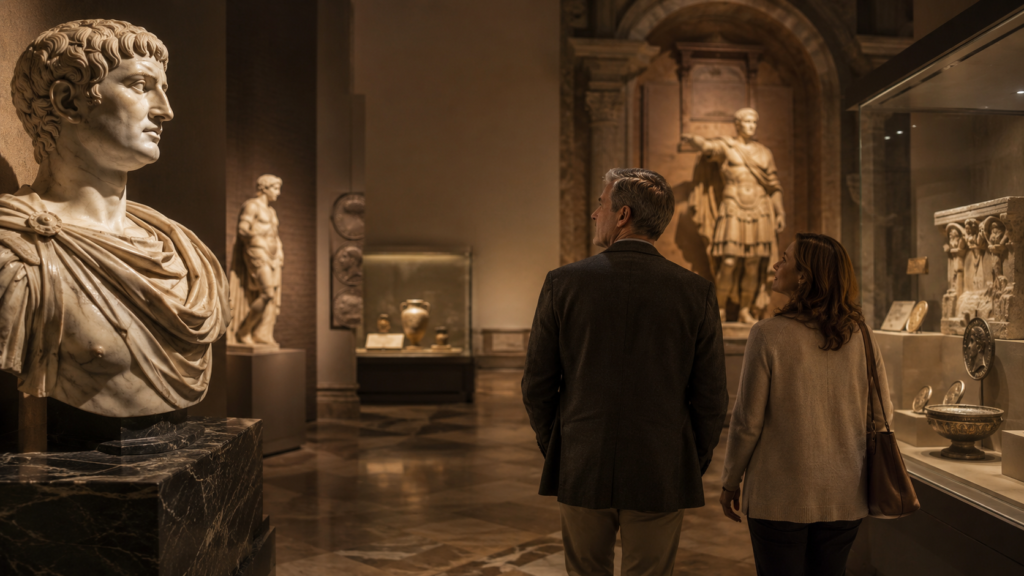
Last week, Lori and I had the opportunity to visit the Saint Louis Art Museum. One of the exhibits we especially enjoyed focused on the reign of the Roman emperor Trajan, who ruled during the second century AD, when the Roman Empire was near the height of its strength and influence.
As we walked through the exhibit, we viewed sculptures, coins, and other objects that had survived for nearly two thousand years. Together, they told the story of a vast empire, great military campaigns, ambitious building projects, and a leader seeking to shape the world around him.
I am certain Trajan’s days were filled with urgent matters. His reign included battles to fight, political tensions to navigate, problems to solve, and countless voices demanding his attention. Yet none of those daily emergencies were displayed in the museum. What remained were the things that defined his reign and shaped his legacy.
That thought has stayed with me.
Like Trajan, our lives are also filled with urgent matters. There’s always another phone call, another email, another problem, another meeting, or another request demanding our immediate attention. But when all is said and done, will we have spent our lives simply responding to whatever was loudest, or will we have remained faithful to the work God called us to do?
The urgent is always loud.
It insists that everything else must be set aside. It creates the feeling that every matter must be handled immediately. When we continually surrender to that pressure, we can spend our days reacting to circumstances rather than living with purpose.
Our decisions become reactionary rather than intentional, prayerful, and purposeful. Our schedules become crowded. Our minds become anxious. Our souls become weary. Eventually, we may become so consumed with managing the moment that we lose sight of the mission.
Nehemiah understood this danger.
God had called him to rebuild the walls of Jerusalem. The work mattered. It represented the restoration, protection, and renewed hope of God’s people. But while Nehemiah was building, Sanballat and Geshem repeatedly asked him to leave Jerusalem and meet with them. Their invitation sounded important. It may have even appeared urgent. But Nehemiah discerned that it was a distraction intended to pull him away from his assignment.
His response was clear:
“I am carrying on a great project and cannot go down.” — Nehemiah 6:3
Nehemiah knew what God had called him to do.
He didn’t allow the expectations of others to determine his direction. He refused to abandon the work simply because another voice demanded his attention. Four times they sent the same message, and four times Nehemiah gave the same answer. “I cannot come down.”
That doesn’t mean we should become uncaring, unavailable, or insensitive to the needs of people. Jesus often allowed Himself to be interrupted. He stopped for the sick, the hurting, the overlooked, and the broken. But Jesus was never controlled by the chaos around Him. He lived in close communion with the Father. From that place of spiritual peace and clarity, He knew when to stop, when to remain, and when to move on. He responded with compassion, but He lived with purpose.
That is the kind of life I want to live!
I don’t want the loudest voice to become the guiding voice. I don’t want the crisis of the moment to continually replace the calling of God. I want to lead from prayer rather than pressure, conviction rather than chaos, and purpose rather than panic.
There will always be something urgent. But not everything urgent is important. Not everything demanding our attention deserves to determine our direction. And not every opportunity is part of our assignment.
Sometimes faithfulness requires us to stop and respond. At other times, faithfulness requires us to remain at the wall and say, “I am carrying on a great work and cannot come down.”
The difference is discernment.
We must spend enough time in God’s presence to recognize His priorities. We must allow the Holy Spirit—not pressure, fear, anxiety, or the expectations of others—to order our steps. The goal is not simply to become more productive. It is to become more faithful.
Long after the emergencies of this week have been forgotten, the work God has given us will still matter. May we have the wisdom to recognize it, the courage to protect it, and the faithfulness to complete it.
Today’s Prayer
Heavenly Father, thank You for the call and commission You have given me. I remain grateful for the privilege, but I also recognize how easily I can become distracted by all the noise around me and the demands placed upon me. So, help me today to recognize Your voice above all other voices. Give me clarity of purpose and wisdom in every decision. Make me discerning enough to know when to remain focused and when to slow down and respond with compassion to the needs of others. Give me courage to resist distractions and the grace to release what’s not mine to carry. Help me live well and operate from a place of peace and clarity. I pray this in Jesus’ name, amen.
Discover more from CHUCK HILL TODAY
Subscribe to get the latest posts sent to your email.